
Norway on Screen: Backdrop or Destination?
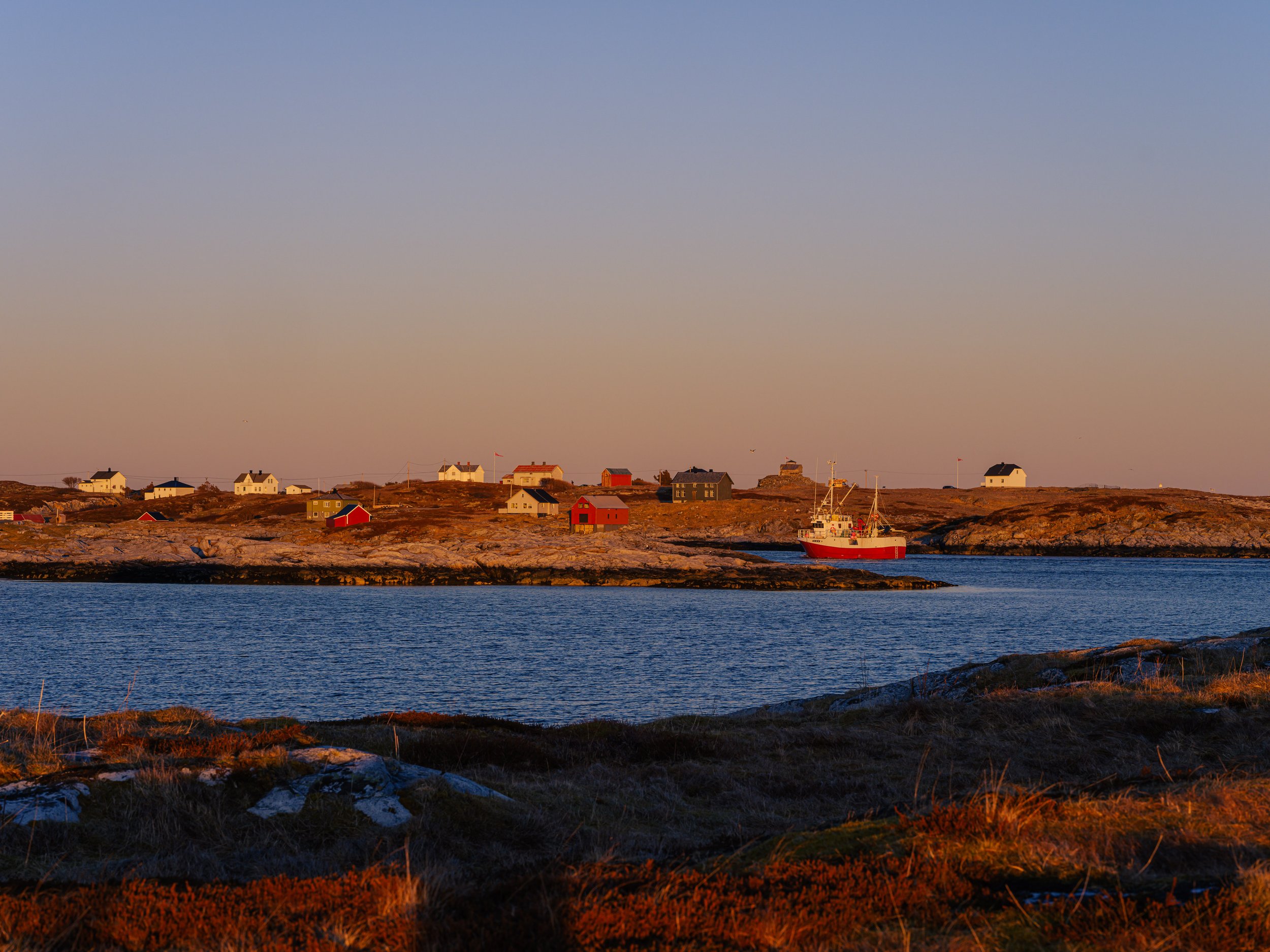
Coastal village on Frøya island, Norway, with traditional houses, a fishing vessel and rocky shoreline in warm evening light. Frøya won the EUFCN Location Award 2024, recognised for its role as a filming location for Netflix's Billionaire Island and its efforts to attract international film productions.
International film and television productions bring Norway considerable attention.
But what does that exposure actually mean for Norwegian tourism?
I believe we need to distinguish more clearly between productions that use Norway as a spectacular backdrop and those that tell stories which genuinely inspire people to visit.
When Tom Cruise was hanging off Preikestolen, or Pulpit Rock, during the filming of Mission: Impossible – Fallout, many people in Norway's tourism industry must have imagined what extraordinary international exposure this could generate.
But when the film reached cinemas in 2018, the story was set in Kashmir.
Preikestolen was every bit as spectacular. It simply wasn't Norwegian as far as the cinema audience was concerned.
This caused frustration within parts of the tourism industry. Here was one of the world's biggest film stars, one of Norway's most recognisable natural landmarks, and an international audience numbering in the millions. Yet viewers were not told that the dramatic sequence had actually been filmed in Norway.
Tom Cruise, however, returned. And this time the filming was even more spectacular.
For Mission: Impossible – Dead Reckoning Part One, Cruise performed what has been described as one of the biggest stunts in cinema history. He rode a motorcycle off Helsetkopen, a mountain rising 1,246 metres above sea level near Hellesylt in western Norway, before releasing the motorcycle and parachuting into the valley below.
He performed the jump six times in a single day.
The footage travelled around the world, attracting enormous attention. But once again, the Norwegian landscape represented somewhere else. This time it was Austria.
And while Preikestolen is an established tourist attraction that many visitors can reach on foot, Helsetkopen lies in far more demanding mountain terrain. Guided excursions are available, but for most travellers it is considerably less accessible than Preikestolen.
Cruise also returned to Norway for Mission: Impossible – The Final Reckoning, this time filming on Svalbard.
These productions say a great deal about Norway's attractiveness as an international filming destination. We have extraordinary landscapes, skilled film professionals and locations capable of accommodating productions on a remarkable scale.
And that has considerable value in itself.
At the same time, these examples demonstrate how different the economic value of a production can be from its value to tourism.
The stunts, press coverage and extensive behind-the-scenes footage generated significant international attention for Norway. Many people discovered where the scenes had actually been filmed, even though the stories were set elsewhere.
But how many people wanted to visit Norway as a result? How many actually did? And what other experiences could the tourism industry offer those who became curious?
This illustrates a question I have been interested in for a long time, both as a filmmaker and through my many years working in Norwegian tourism.
What is the difference between attracting an international film production to Norway and inspiring that production's audience to visit?
And how can we become better at understanding and making use of that difference?
Norway is an attractive filming location.
But what are we telling the world?
Norway has an impressive list of international film and television productions that have used locations across the country.
Christopher Nolan filmed parts of Tenet in Oslo. Alex Garland's Ex Machina featured Juvet Landscape Hotel in Valldal, although the story was set in Alaska, while Star Wars: The Empire Strikes Back transformed Finse and the Hardangerjøkulen glacier into the ice planet Hoth.
The James Bond film No Time to Die offers a slightly different example. It opens with a dramatic sequence set in Norway's winter landscape, filmed partly around Hakadal and Lake Langvann near Oslo. Later in the film, the Atlantic Ocean Road also plays a prominent role.
Here, Norway is actually Norway.
And in a rather delightful detail, Fantorangen, a character from Norwegian children's television, appears on a TV screen. The production had contacted Norwegian broadcaster NRK for footage representing Norwegian children's culture.
This is, of course, positive for the Norwegian film industry.
International productions purchase services from Norwegian production companies, film professionals and suppliers. They use hotels, transport, catering and other local infrastructure. They create employment, develop expertise and strengthen Norway's position as a filming destination.
These are benefits we should not underestimate.
But when we turn our attention to tourism, a different question emerges.
If audiences believe they are looking at Alaska, Kashmir or another planet, how does that influence their desire to visit Norway?
It certainly can.
An extraordinary landscape can arouse curiosity. A filming location can gain a life of its own through press coverage and social media. Fans may want to visit a place precisely because their favourite film was shot there.
But this depends on people actually discovering where the location is.
And that is quite different from a film or television series presenting Norway as a destination within the story itself.
International film production is also business development
Any discussion about the value of international productions in Norway should also consider the country's film incentive scheme.
Introduced in 2016 and administered by the Norwegian Film Institute (NFI), the scheme allows qualifying productions to apply for a rebate of up to 25 per cent of eligible production expenditure in Norway.
I believe it is important to view this as more than conventional film funding.
International productions are also businesses. They purchase Norwegian services, generate contracts and employment, and use accommodation, restaurants, transport and other local infrastructure. They contribute to skills development and can help strengthen Norway's international competitiveness as a production location.
The current scheme operates within a limited financial allocation. Applications are assessed and ranked, meaning that even productions meeting the eligibility requirements may not receive a rebate.
That raises an interesting question of economic policy.
Should we increasingly regard the scheme as a predictable investment incentive, where international productions meeting defined requirements for scale, activity and economic contribution can plan around a known rebate?
Naturally, such an approach would also require careful examination of its public costs and wider economic benefits.
Another question concerns which types of productions should be eligible.
The current regulations exclude reality and entertainment programmes. Yet some international travel and entertainment programmes may reach audiences that are particularly relevant to Norwegian tourism.
That does not mean every such production should receive public funding. But I believe it is worth examining whether the eligibility criteria adequately reflect the full range of economic opportunities.
We must, however, keep two things separate: the value created while a production is taking place in Norway, and its potential impact on tourism after release.
Both can be substantial. But they need to be documented and evaluated differently.
When Norway becomes part of the story
There are also productions in which Norway is more than a visual backdrop. The country becomes part of the narrative.
In the fourth season of HBO's Succession, the characters travel to Norway. Juvet Landscape Hotel and the Romsdalen region play prominent roles, allowing viewers to experience the landscape, architecture, accommodation and surroundings through the characters' encounter with the country.
Norway is not pretending to be somewhere else. Norway is Norway.
That makes a difference.
When audiences see a hotel, restaurant or landscape that forms a natural part of a story, the connection between what appears on screen and the actual destination becomes much clearer.
And unlike a spectacular film stunt on a mountain cliff, these are experiences that visitors can often book and enjoy themselves.
This does not mean everyone watching Succession suddenly wants to travel to Romsdalen. But for an audience already interested in architecture, design, distinctive accommodation and nature, such scenes may make a particular destination more attractive.
It also matters who is watching.
A major Hollywood film may reach an enormous audience, but only a small proportion of those viewers may be likely to travel to the location where it was filmed.
A smaller production, on the other hand, may reach people who already have a strong interest in precisely the kinds of experiences a destination offers.
I therefore believe we should discuss more than audience numbers. We should also consider who those viewers are, what motivates them, and what tourism value the exposure might actually create.
Nor does the entire story have to take place in Norway. A visit, a journey or even a few scenes may be enough to inspire interest, provided the location is recognisable and the experience resonates with the audience.
What matters is not simply where the camera was positioned, but what the audience takes away from the experience.
When Norwegian stories reach the world
We should not overlook the importance of Norwegian productions that reach large international audiences either.
Roar Uthaug's Troll, released on Netflix in December 2022, is a particularly interesting example.
Drawing on Norwegian folklore, the film places its story in recognisable Norwegian surroundings. Dovrefjell, Jotunheimen, Trollveggen and Oslo are more than spectacular filming locations. The landscape and the mythology surrounding trolls form part of the story itself.
The film became an enormous international success.
According to Netflix, Troll recorded 103 million views during its first 91 days, making it the platform's most popular non-English-language film by that measure.
Its sequel, Troll 2, released in 2025, also reached a considerable audience. Netflix reported 44 million views during the second half of 2025.
What makes these films interesting is that they do more than showcase Norwegian scenery. They introduce Norwegian folklore, cultural history and ideas about the landscape to an international audience.
But once again, we must ask the same question.
How many of those millions of viewers were genuinely inspired to visit Norway?
We do not know.
It is therefore encouraging to see that Visit Norway has created a dedicated guide to the filming locations featured in both films, including information about how visitors can experience the real places.
This is a way of using interest in the productions to tell a broader story about Norway as a destination.
And it does not necessarily require developing a dedicated troll attraction for everyone who has watched the films.
Perhaps the interest could just as easily lead someone towards a railway journey through Romsdalen, a visit to Jotunheimen or a few days in Trondheim.
For me, Troll and Troll 2 illustrate another important dimension of this discussion. Norwegian films can introduce our landscapes, culture and stories to audiences far beyond our borders.
But significant international attention is still not the same as a documented tourism impact.

Trondheim, Nidaros Cathedral, Jotunheimen and several other Norwegian locations feature in the sequel.
Some experiences from my own productions
In 2017, we travelled across much of Norway to photograph and film the country.
It was an extensive period of production involving countless locations and a considerable amount of photographic and film material.
These were not conventional commissioned commercial productions. They grew out of our own desire to show Norway through our visual storytelling.
Along the way, we collaborated with Visit Norway and several destination organisations that purchased photographs for their own image libraries. That income helped cover the costs of the productions.
The attention we received, including internationally, was considerable.
I learnt a great deal from the experience, not least how powerfully good photography and filmmaking can influence people's perceptions of a place.
But it also made me increasingly interested in what happens after someone has seen the images.
A spectacular landscape can make people stop and look. It can encourage them to share the content and talk about what they have seen.
But does that mean they want to travel there?
And if the answer is yes, what will it take for them actually to make the journey?
These are questions I have continued to explore through film production, photography, brand development and consultancy.
Having previously worked for NHO Reiseliv (the Norwegian Hospitality Association), as well as in destination development, I have naturally been interested in the relationship between storytelling and commercial value.
Because it is entirely possible to generate significant attention without necessarily increasing revenue for tourism businesses.
Attention has value. But it is not the same as a documented tourism impact.
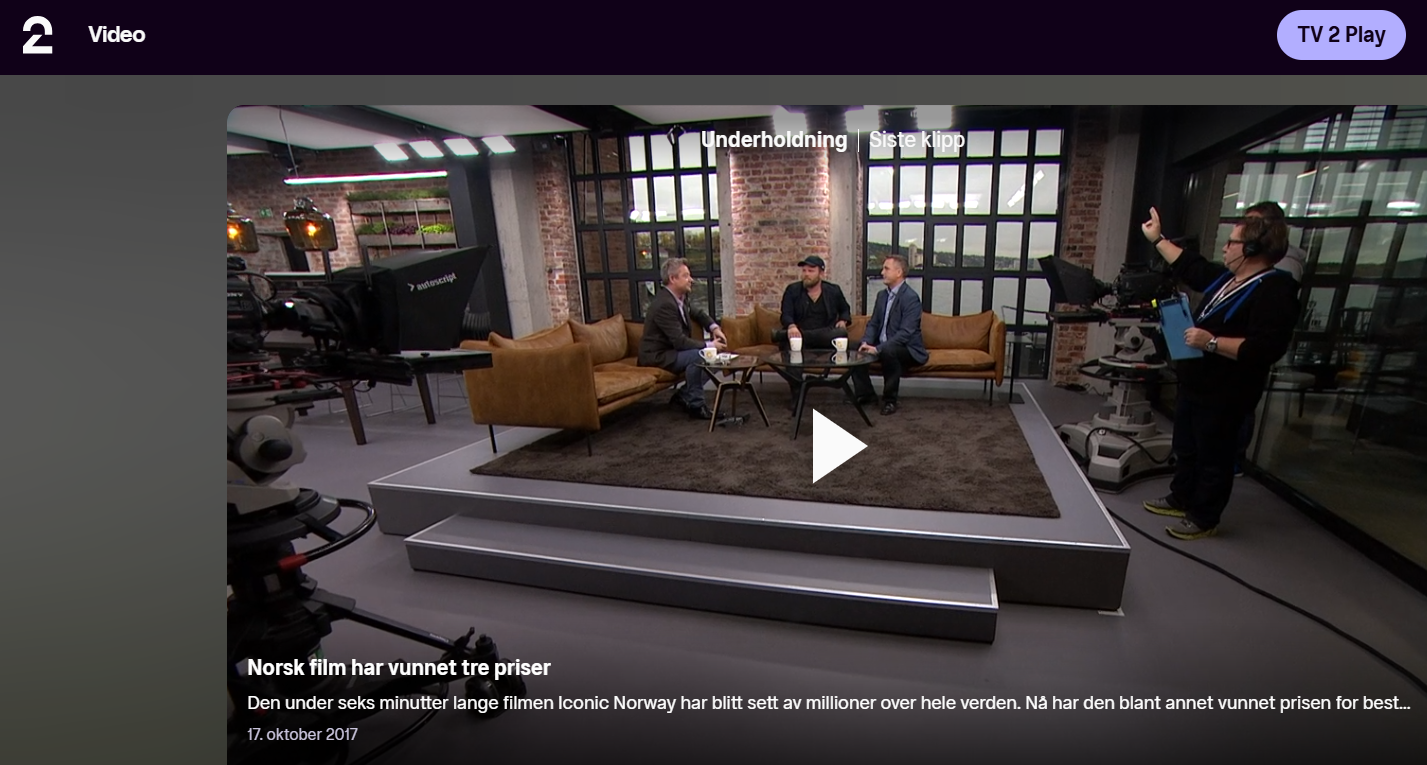
FotoKnoff on Norwegian broadcaster TV 2, 17 October 2017. A report on the international attention and awards received by Iconic Norway. Click the image to watch the report on TV 2. The interview is in Norwegian.
In this TV 2 report, Iconic Norway receives national attention after reaching millions of viewers internationally and winning several film awards, including at Cannes Corporate Media & TV Awards.
I have included this interview because it illustrates the international attention our work generated at the time, and provides some background to the questions I am exploring in this article.
When the journey itself becomes the story
From a tourism perspective, I find some of the most interesting productions are those in which the journey and the experiences are central to the content.
We have seen several good examples in recent years.
In Apple TV+'s Long Way Home, Ewan McGregor and Charley Boorman travel through Europe on motorcycles. Norway features prominently in episode four, Fjord Focus, as they ride Norwegian roads, experience the fjord landscapes and encounter the country's nature and culture along the way.
In the following episode, they visit Svalbard.
I contributed footage to this production and received very positive feedback from the team abroad.
I also supplied material to the BBC series Martin Compston's Norwegian Fling, in which actor Martin Compston and presenter Phil MacHugh travel through Norway.
These productions represent something different from the traditional use of Norwegian filming locations.
Viewers experience Norway alongside the people on screen.
They encounter local communities, nature, culture, food and people. They gain an impression of what travelling through Norway might actually feel like, and how they could enjoy similar experiences themselves.
This is a form of storytelling I strongly believe in.
Not because such programmes necessarily attract larger audiences than international feature films, but because the distance between what viewers experience on screen and what they might do themselves becomes smaller.
Of course, not everyone who watches a travel programme will book a holiday.
But a programme may help Norway become one of the destinations they genuinely consider.
And that can be the beginning of a travel decision.
Joanna Lumley and the rise of Northern Lights tourism
One of the most interesting historical examples is Joanna Lumley in the Land of the Northern Lights, broadcast on British television in 2008.
The documentary follows Joanna Lumley's journey north to fulfil a long-held dream of seeing the Northern Lights.
What makes this production particularly interesting is the personal story.
Lumley is not simply observing a spectacular natural phenomenon. We share the anticipation, the journey, the encounters along the way and, finally, the deeply emotional experience of seeing the aurora.
For millions of British viewers, the Northern Lights became something more than a beautiful phenomenon in a photograph.
They became an experience people could dream of having themselves.
The documentary has subsequently been highlighted as an important contributor to the growth of Northern Lights tourism in Tromsø and Northern Norway.
But I think it is important to look more closely at what actually happened.
Research discussed by UiT The Arctic University of Norway describes how the tourism industry in Northern Norway had already begun developing dedicated Northern Lights experiences. Hurtigruten had worked strategically with the British market, while tourism operators in Tromsø had introduced systems that made it easier for visitors to book Northern Lights excursions.
Much of the groundwork was therefore already in place when the BBC documentary attracted increased interest.
It would be wrong to attribute the substantial subsequent growth in Northern Norway's tourism industry to one television programme alone.
Air connections, international marketing, product development, changing travel habits and numerous other factors also played important roles.
Nor do we have sufficiently robust evidence to isolate exactly how much of the growth was caused by that particular documentary.
Nevertheless, I believe the example illustrates something important.
A compelling story can help generate interest in a destination. And when the tourism industry has already developed experiences that meet that demand, the interest can have commercial value.
That may be one of the most important lessons we can take from it.
The Trip to the Northern Lights: A production worth watching
One British production I am particularly interested in is The Trip to the Northern Lights. Its first two episodes premiered at the BFI London Film Festival on 17 October 2026. Starring Steve Coogan and Rob Brydon, it is the fifth instalment of the acclaimed series directed by Michael Winterbottom.
The format brings together comedy, gastronomy, culture and travel. This time, the journey takes the pair through Scandinavia, including remote Norwegian fishing villages and restaurants.
I see considerable potential here.
British audiences will not simply be looking at beautiful landscapes. They will encounter places through food, people, conversation, humour and the kind of journey they may be able to imagine making themselves.
That is an important distinction.
At the same time, this is not a conventional travel documentary. The format combines scripted elements, improvisation and fictionalised versions of the two performers.
It is first and foremost an entertainment production, but the journey and the real places they visit are central to the experience.
The series does not necessarily need to make viewers want to visit a specific filming location. It may also stimulate a broader interest in Norwegian gastronomy, landscapes, local culture and distinctive accommodation.
That could be commercially relevant to Norwegian tourism.
We must, however, be careful not to draw conclusions too early.
We do not yet know how the series will affect travel interest, which audiences will respond most strongly or whether that interest will lead to actual bookings.
Nevertheless, I believe this is a production that the Norwegian tourism industry should follow closely.
And it becomes even more interesting when considered alongside Innovation Norway's new tourism marketing strategy.
Innovation Norway's new strategy makes the discussion even more relevant
Innovation Norway has recently published its tourism marketing strategy for 2026–2030.
What I find particularly interesting is how clearly it points towards a broader story about Norway.
Our fjords, mountains and Northern Lights are already internationally recognised. Innovation Norway now wants more visitors to discover our culture, food, people and local communities.
Norway should not simply be a country people visit to admire beautiful scenery. It should be a destination offering meaningful experiences, fresh perspectives and encounters with a society in which nature has also shaped our culture and way of life.
The overarching positioning is North of the Ordinary – It's in our nature.
Another important development is the clearer prioritisation of the international audiences Norway wants to reach.
The United Kingdom is the highest-priority market among geographically close markets, with target groups interested in areas including arts and culture, nature, adventure and comfortable relaxation.
Germany, Spain and Italy are also prioritised, particularly among culturally motivated travellers.
I believe this is highly relevant to the discussion about international film and television productions.
When we know which markets we want to reach, what we want to communicate about Norway and which experiences we want to highlight, should we not also examine how international productions might contribute to those ambitions?
We already have examples of how television programmes can make Norway interesting to international audiences.
And many of the experiences featured in such productions are commercial products that visitors can actually book.
Yet I often feel we spend more time discussing the value of attracting a production and the publicity it generates than how that attention might translate into travel interest and economic value.
I believe we should pay more attention to the latter.
Innovation Norway also describes a clear division of responsibilities.
National marketing should build awareness of Norway. Destination organisations should develop interest in their regions, while tourism businesses should help convert that interest into sales.
That seems a sensible approach.
But international film and television productions can generate attention across all these levels.
A single production may make a country, a region, a hotel and a particular experience interesting to an audience.
How we prepare for and respond to that attention should therefore form a natural part of the discussion about international tourism marketing.
I do not find screen tourism identified as a separate strategic instrument in the new marketing strategy.
That does not mean Innovation Norway is not working with such opportunities. The strategy is an overarching framework and is not intended to describe every possible marketing activity.
But I believe this is an area worth exploring further, precisely because of its close relationship with the audiences and ambitions the strategy now identifies.
Britain has already made film and television part of its tourism strategy
The United Kingdom is also an interesting country to learn from.
In January 2025, VisitBritain launched its international Starring GREAT Britain campaign, using well-known films and television productions to inspire international visitors to explore destinations across Britain.
What interests me is not simply that the campaign draws on familiar titles and filming locations.
It also connects that interest with actual itineraries, attractions and experiences.
Digital maps and themed content help audiences discover the places, while collaboration with tourism businesses aims to turn interest into visits and bookings.
VisitBritain also works with the British Film Commission and has conducted research into the influence of film and television on travel interest and destination choice.
In its reporting, VisitBritain estimated that the first six months of Starring GREAT Britain generated £217 million in additional spending by international visitors.
Such estimates naturally need to be understood in the context of the methodology used.
But the important point is that VisitBritain is attempting to measure commercial outcomes, rather than simply counting media coverage and online views.
I think this is a useful example of how film and television can form part of a broader, more systematic tourism strategy.
At the same time, a substantial market for screen tourism does not mean that every destination featured in an international production automatically has an equally substantial market for dedicated film-related experiences.
Sometimes it may be far more valuable to use the attention generated by a film to introduce experiences that already exist, or to make a region more attractive to an audience unfamiliar with it.
What should Norway's tourism industry do differently?
I am not suggesting that Norway should attempt to influence the artistic freedom of international filmmakers.
A director must be free to choose Norwegian mountains to represent Kashmir, Alaska or another planet if that is what the story requires.
Nor should we underestimate the benefits of attracting international productions to Norway, regardless of where the stories are set.
But perhaps we should become better at distinguishing between two different opportunities.
The first is making Norway attractive as a production destination, through strong professional film environments, competitive conditions and compelling filming locations.
The second is understanding which productions have the potential to make Norway more attractive as a travel destination.
These opportunities can complement each other, but they do not necessarily have the same objectives or require the same approach.
When we know an international production is coming to Norway, it should be natural to consider certain questions early in the process, within the limits of confidentiality, editorial independence and intellectual property rights.
Who will the production reach? Will viewers recognise Norway as Norway? Which experiences might interest them? Do relevant products already exist, and are they accessible to international visitors?
Could we prepare information, itineraries and marketing activities for release when the production becomes public, without interfering with the filmmakers' work?
And how should we investigate whether the exposure has any measurable effect?
For tourism, success should involve more than press coverage, shares and website visits.
It should also concern the visitors who actually arrive, how long they stay, what they experience and the economic value their visits generate locally.
Innovation Norway's new strategy is clear on these ambitions. Among other measures, it emphasises more overnight stays outside the peak season, higher visitor spending and stronger international interest in Norwegian culture and experiences.
I believe there is significant potential for closer cooperation between film commissions, production companies, destination organisations, Innovation Norway and tourism businesses.
Not to turn every international production into an advertisement for Norway, but to be better prepared when a genuine opportunity arises.
We should also ask who we want to attract
There is another perspective I believe matters.
Norwegian tourism does not necessarily need the greatest possible number of visitors to the same places during the same few weeks of the year.
Some destinations already face challenges from heavy visitor traffic, pressure on the natural environment and limited local economic benefit from certain forms of tourism.
An international production that inspires longer stays, good food experiences, local activities and visits outside the peak season may therefore be more interesting than one that primarily creates queues at a famous viewpoint.
This is where understanding the target audience becomes especially important.
Who do we want to reach? What interests them? What are they willing to pay for? And what experiences do we want them to take home?
These questions are just as relevant to screen tourism as they are to other areas of destination development.
And the answers cannot necessarily be found in the number of millions who have watched a film.
That is why I find Innovation Norway's move towards more targeted marketing and greater economic value particularly interesting.
It also provides a useful starting point for assessing which types of international film and television exposure could genuinely support the direction in which Norwegian tourism wants to develop.
From attention to the desire to travel
I have spent a substantial part of my professional life working with tourism, food, photography, film and storytelling.
Through these different fields, I have seen how closely connected they can be, but also how different their objectives and methods are.
A good film should first and foremost be a good film.
A good travel experience should be worth making the journey for.
When these two meet, something valuable can emerge for both industries.
But it does not happen automatically.
I believe we have much to gain from investigating this more thoroughly, through research, actual market data and the experiences gained from productions that have already introduced Norway to international audiences.
We need a better understanding of what really influences travel decisions.
We need to distinguish between general attention and genuine interest in a particular destination.
And we need to know more about what ultimately turns that interest into bookings.
Innovation Norway's new marketing strategy sets out a clear direction for the audiences we want to attract and how Norway should be perceived as a destination.
International film and television productions can be one of several ways to support those ambitions.
But to make the most of them, we need to understand the differences between productions and be prepared for the opportunities they may create.
For me, this is not about choosing between major international feature films and smaller travel programmes.
Both can create substantial value.
It is about understanding what kind of value we are talking about, who benefits from it and what it takes to make that value greater.
We have become very good at showing the world what Norway looks like. Perhaps we should be equally interested in the stories that make people want to come here.
Sven-Erik Knoff
Filmmaker, photographer and brand strategist
FotoKnoff®
Filmography and production credits on IMDb
Sources and further reading
Norwegian Film Institute: Film and Television Incentive Scheme
Visit Norway: Mission: Impossible filming locations in Norway
Innovation Norway: Norwegian film wins awards in Cannes, 2017
UiT The Arctic University of Norway: How the Northern Lights became a tourism attraction
BFI: Michael Winterbottom discusses The Trip to the Northern Lights
